Tech Fatigue: Why Ordering a Burger Shouldn't Require an Onboarding Process
Tech Fatigue: Why Ordering a Burger Shouldn't Require an Onboarding Process
There was a time when grabbing a quick bite meant exactly that: walk in, order, pay, leave. On a recent episode of Ride or Die, Greg Provance and Spiro Douvris dig into a LinkedIn post that captured a feeling a lot of operators and guests share: "I miss when ordering a burger didn't require an onboarding process." Download the app. Verify your email. Allow notifications. Enable location. Join the rewards program. Browse a limited menu. Enter a promo code. Choose a tip percentage. What used to take three to five minutes now takes closer to twenty.
What is "tech fatigue" in restaurants, and why is it happening now?
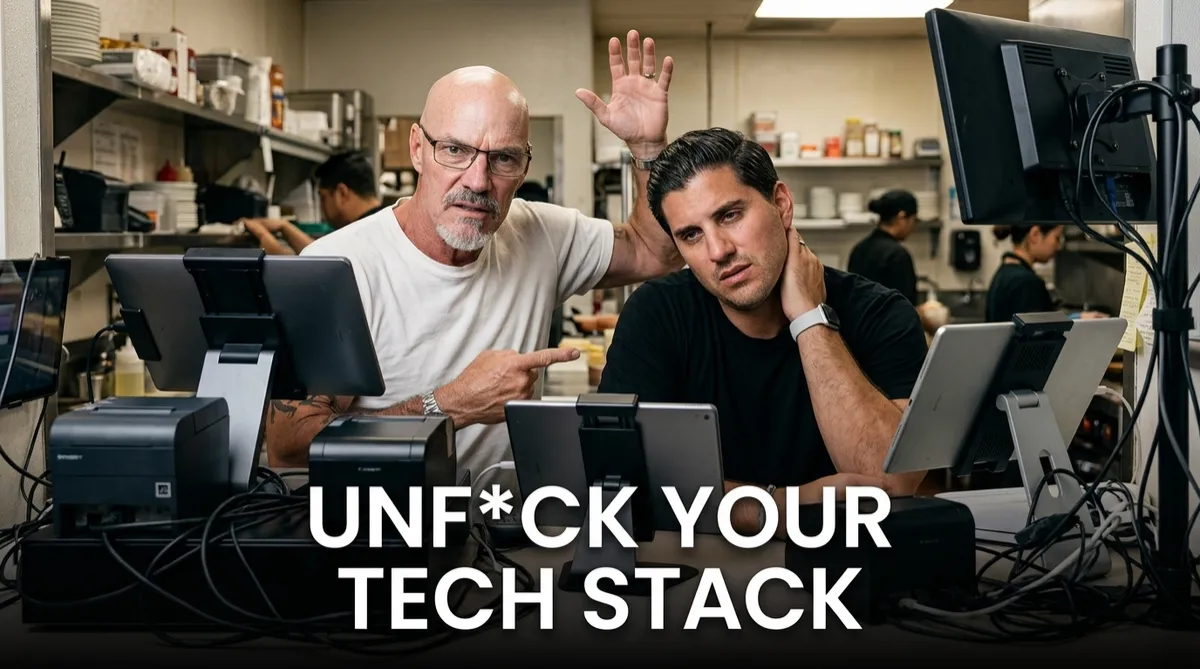
It's the accumulation of tool after tool stacked on top of an operation without anyone stepping back to ask if the stack still makes sense. Douvris points out that restaurants used to run on a handful of high-profile POS systems and not much else. Then, in his words, "Silicon Valley decided" the industry needed more. Provance describes the trap from the inside: you onboard a new piece of technology, realize it needs to be actively managed, and instead of fixing the root problem you bolt on another tool to patch the gap. The result is operators and guests both drowning in touch points that were each sold as a fix.
Why does so much restaurant technology feel like sales, not service?
Douvris is blunt about the pattern: "It's all sales, no service." A salesperson promises a product will solve everything, gets the signature, and once the contract is signed the support often ships overseas or disappears into a help-tutorial nobody has time to watch. "No restaurant person has time for that," he says. Operators end up locked into a commitment for software that never delivered what the pitch promised, while quietly paying for it every month.
Has technology actually replaced hospitality?
Douvris reframes the real shift: "Profit margins have replaced hospitality." Operators got into the business to serve their community and watch people enjoy their food, not to chase margins, since restaurant margins were never the draw in the first place. But once margin becomes the obsession, service is the first thing that gets cut to protect it. The result, as Provance puts it, is a McDonald's run-through that works fine as a transaction but feels like "somebody took a vacuum and sucked the energy out of the place."
Why does the Starbucks app work when so many restaurant apps don't?
Because the tech and the hospitality show up together instead of one replacing the other. Provance is candid that his Starbucks app is the only food app on his phone, and the reason is simple: it's fast, it's everywhere, and when he walks in to pick up his order he still gets a genuine "how's it going" and a name written on the cup. "I'm using the technology and I'm getting the warm and fuzzies," he says. "Win win." The technology removes friction without removing the person.
How should an operator decide what technology to bring into their restaurant?
Start with the customer profile, not the sales pitch. Douvris lays it out plainly: an old-school steakhouse with a 35-and-up clientele should lean away from heavy tech, since that guest wants a phone call and a real reservation conversation, not another app to download. A concept skewing younger needs more of the digital infrastructure, because, as Douvris puts it, that audience doesn't lean on the same social interaction to feel taken care of. Provance adds a second filter on top of demographics: name the specific problem you're trying to solve before you buy anything, then check honestly whether the tool solved it or just created a new one.
What actually went wrong with self-order kiosks and QR-code tables?
Provance describes ripping out early order kiosks at one of his restaurants after they failed to speed up a line out the door the way the team expected, deciding instead to fix internal processes. A QR-code rollout at a separate restaurant group's outdoor tables went sideways for a different reason: servers assumed guests ordering through the app no longer needed service, and quietly downgraded themselves to "drink runners and bussers." Guests still expected the same hospitality they'd get inside, and now had to fight through an unfamiliar app to get it. The fix wasn't removing the QR codes, it was requiring servers to walk every table through the app and still deliver full service, which let those same servers handle three or four more tables than the ones working without it.
What's the line between technology that helps and technology that hurts?
Ask two questions from the guest's side of the counter, Provance says: would I actually use this, and would I be excited to use it. A loyalty program buried behind three or four onboarding steps is dead on arrival. One that takes seconds to join is worth rolling out. The technology's job is to remove burden, not transfer it from the operator onto the guest or the team member standing at the register.
If every restaurant has access to the same tech stack, what actually separates one from another?
Food and hospitality, exactly like it's always been. Douvris makes the point directly: once two competitors have comparable technology, the tech stops being the differentiator and the fight goes right back to the two things it was always about. He adds a warning about internal dependency, too: when only one person in the building actually understands a piece of software, that person leaving turns a tool into a liability overnight.
The takeaway: form the tech around your culture, not your culture around the tech
Douvris lands the line that framed the whole conversation: "Don't let the tech form your operations around the tech. Have the tech form around your operation." Restaurants that lose their identity chasing every new tool have the relationship backwards. Used well, technology should spread a restaurant's actual identity further, not replace it. As Provance puts it, the goal is to use tech to enhance hospitality, never to substitute for it.
More from the Rundown: for more on keeping your operation lean and intentional, see Cut Your Menu 30% or Keep Bleeding Money, Third-Party Delivery Isn't Killing Your Restaurant. Your Mindset Is., and You're Not Broke, You're Just Bad at Cash Flow.
If your team can't tell you when a piece of technology is creating more work than it saves, that's a visibility problem in your leadership, not a technology problem. That's exactly what the Leadership Circle exists to fix. Learn more about the Leadership Circle
Listen to the full conversation, "Tech Fatigue: Why Ordering a Burger Shouldn't Require an Onboarding Process," on the Ride or Die podcast, Episode 7, at gphospitalitypartners.com/podcast.