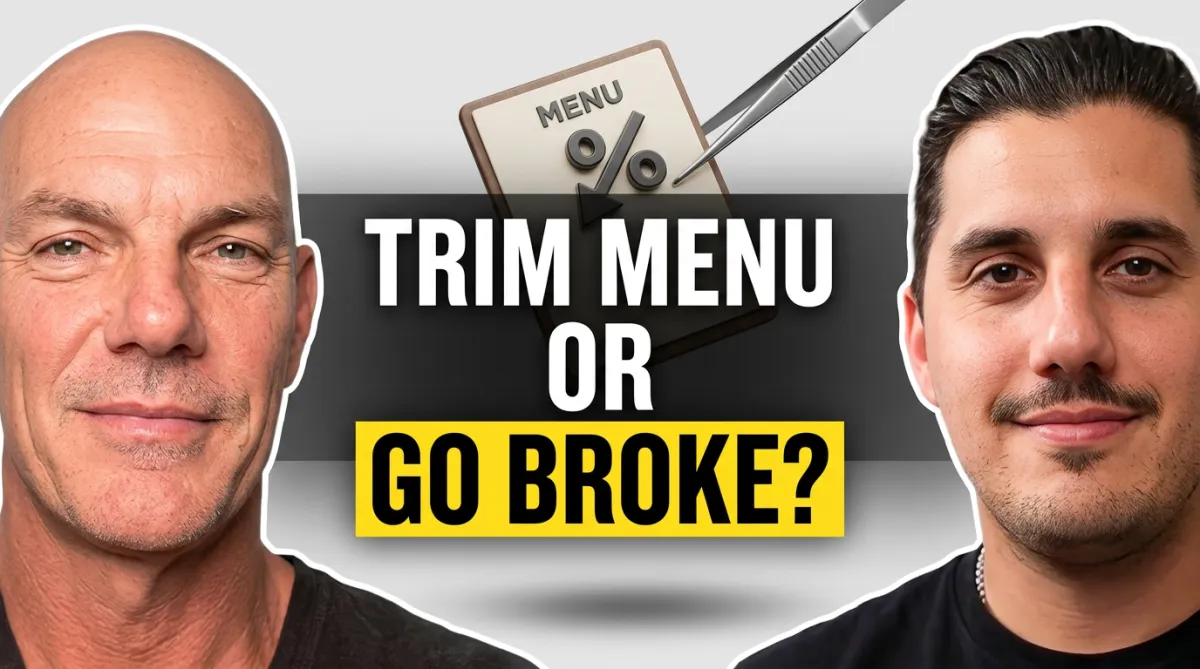
Cut Your Menu 30% or Keep Bleeding Money
Ask a restaurant owner to cut their menu by 30% and watch what happens to their face. On Episode 4 of the Ride or Die Restaurant Show, Greg Provance and Spiro Douvris use that gut-check question to get at a real problem: most menus are carrying items that cost money to keep and aren't earning their place.
The 30% question isn't really about 30%
Thirty percent is a provocation, not a mandate. The real question underneath it is simpler: when's the last time you actually pulled your P-mix, the sales report that shows exactly what's moving and what isn't, and looked hard at what it's telling you? A lot of operators haven't checked in six months, a year, or ever. That means there are items on the menu right now that someone is convinced are essential, that customers have quietly stopped ordering.
The 80/20 rule is not a myth
Roughly 20% of menu items tend to generate 80% of sales. McDonald's is reported to cut anything doing under 4% of total sales. Whether or not that exact number still holds, the principle does: most menus are carrying dead weight, and it's costing more than shelf space.
Do the daily math, not the monthly math
A menu item that sold 60 units this month sounds fine until you divide it by 30 days and realize that's two a day. At $15 a plate, that's $30 a day propping up an item that still requires inventory, prep labor, and training time. The monthly number hides the truth. The daily number doesn't.
It's not always about deleting the item
Sometimes the fix isn't cutting a dish, it's simplifying it. A salad with ten ingredients creates constant substitution requests, slows down the line during a rush, and half the toppings go unwanted anyway. Capping ingredient count and charging a small upcharge for extras can save massive prep time without losing the dish. The same logic applies to ingredient life cycle: count the actual steps a case of tomatoes goes through before it lands on a plate, and look for ways to cut steps, not just items. A five-dollar tomato slicer eliminated hours of inconsistent hand-prep in one kitchen simply by removing a step nobody had questioned.
Customization without menu bloat
The best menus often aren't the smallest, they're the most structured. An Italian restaurant that offers a handful of pastas and a handful of preparations lets a guest build their own dish in two quick decisions instead of scanning twenty items. Chipotle runs the same play: four or five base formats, a handful of proteins, endless perceived variety, minimal actual menu complexity. That's the target: a lean core that still feels like choice.
What to do after you cut
Cutting isn't the finish line. A slimmer menu creates room to rotate seasonal items, run limited-time offers that stay limited instead of quietly becoming permanent, and try collaborations with other local restaurants or vendors, still an underused move in this industry. Talk to your vendors too. Most have culinary teams who'll help reformulate or reposition a struggling item for free, since it's in their interest to keep you buying from them.
Where to start
If cutting 30% feels impossible, start smaller: a 10% cut on a 30-item menu is three items. If you can't find three items that aren't earning their spot, that's worth a hard look on its own. Make reviewing the P-mix a weekly habit, not a once-a-year event, so decisions come from data building up over time instead of a single panicked audit.
Quick Takeaways
- Pull your P-mix and check it against daily, not monthly, sales to see which items are actually underperforming.
- Roughly 20% of menu items typically drive 80% of sales; items far below that threshold are candidates to cut or fix.
- Simplifying a dish (fewer ingredients, fewer prep steps) can save as much as removing it entirely.
- A smaller, structured menu with built-in customization (like Chipotle's format) can feel like more choice while staying lean to operate.
- Start with a 10% cut if 30% feels too aggressive, and make P-mix review a weekly habit, not an annual one.
FAQ
What is a P-mix in a restaurant, and why does it matter?
A P-mix (product mix) report shows how many units of each menu item sold over a period. Reviewing it regularly reveals which items are actually profitable and popular versus which ones quietly aren't earning their place on the menu.
How do I know which menu items to cut?
Divide monthly sales by days to see true daily performance, then weigh that against cost, prep complexity, and margin. An item selling only once or twice a day that's expensive or labor-intensive to make is a strong candidate to cut or simplify.
Does a smaller menu hurt sales?
Not typically. A focused menu tends to improve consistency, speed of service, and quality, since the kitchen is repeating fewer dishes more often. Structured customization, like choosing a protein or sauce within a smaller set of formats, can preserve variety without the operational cost of a large menu.
More from the Rundown: for more on the financial side of running a restaurant, see Surcharges: Smart Business or Ripping Off Your Customers?, You're Not Broke, You're Just Bad at Cash Flow, and Third-Party Delivery Isn't Killing Your Restaurant. Your Mindset Is.
Building the discipline to actually pull your P-mix every week instead of once a year, and act on what it tells you, is exactly the kind of operational clarity we build into the Leadership Circle. If this conversation resonated, learn more about the Leadership Circle here.
Want more conversations like this one? Subscribe to the Ride or Die Restaurant Show and catch every episode at gphospitalitypartners.com/podcast.