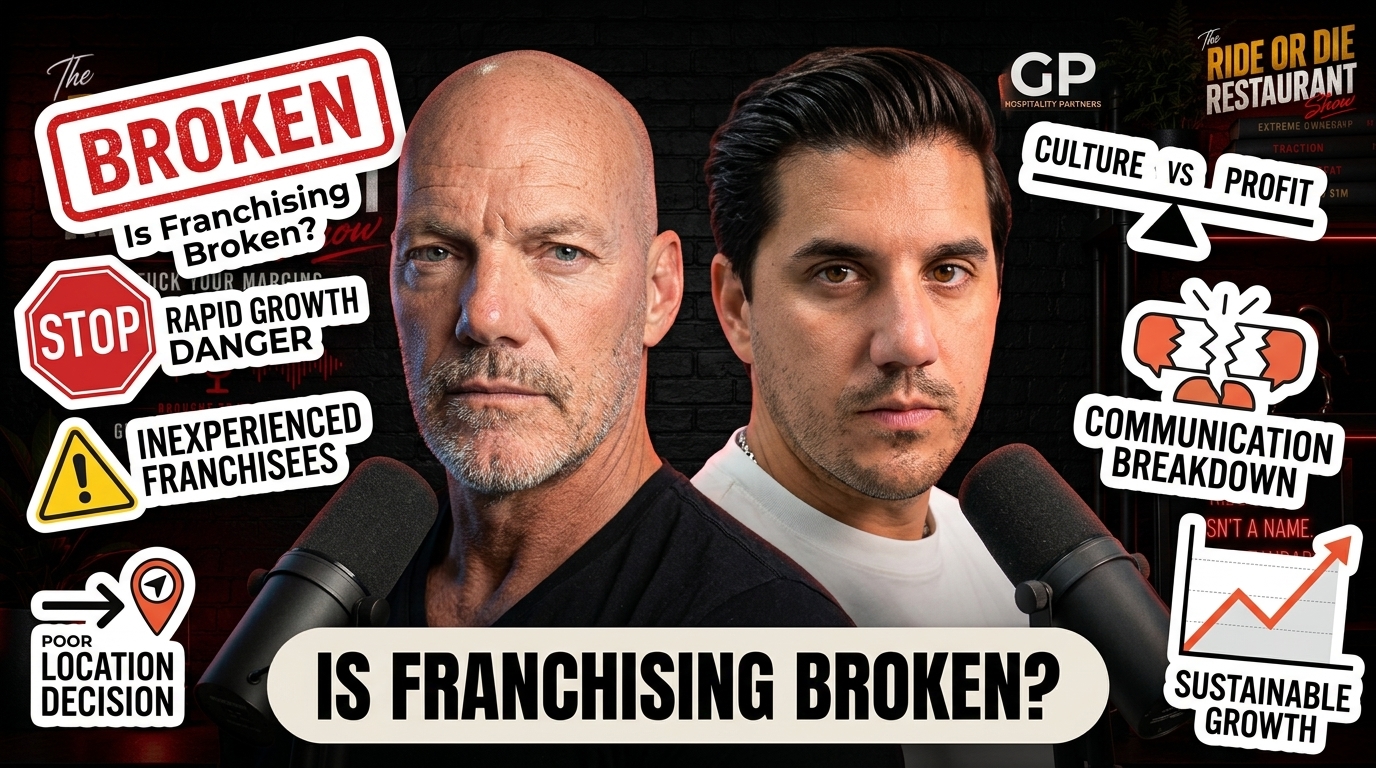
Stop Selling Territories, Start Building Franchisees
Stop Selling Territories, Start Building Franchisees
Every operator thinking about franchising eventually asks the same question: how fast can we grow? On this episode of the Ride or Die Restaurant Show, Greg Provance and Spiro Douvris argue that's exactly the wrong question to be asking, and the data on who actually becomes a franchisee proves it. If the franchise model feels broken right now, it's not because the people entering it have changed. It's because the metrics everyone's using to measure success have.
What's actually broken about the franchise model today?
Spiro doesn't hedge: "I think the franchise model today is broken." The problem isn't the franchisees themselves, it's what the industry chooses to measure. Instead of tracking hospitality and guest experience, most franchise systems are built entirely around how many locations are under development. "It's all about how many stores you have under development rather than are your stores successful," Spiro explains. Private equity has accelerated that shift, rewarding brands for selling territory fast rather than building operators who can actually run what they've bought.
What do the real numbers say about who becomes a first-time franchisee?
Spiro lays out decades of industry data that most operators have never seen broken down this plainly: 80% of franchisees are first-time business owners who will personally run the location. Of those, 70% have no prior experience in the industry they're entering. Only 9% walk in with any restaurant management background. Combine it further and 73% are first-time business owners with hourly-staff experience or less, and 91% of first-time franchisees have no restaurant management experience at all. "I'm a little shocked by those stats," Greg admits, even after years of working directly with franchise operators.
Why does rushing multi-unit deals set franchisees up to fail before they even open?
The pressure to sign five-location deals instead of one has become the new normal, and Spiro connects it directly to the stats above: "You're putting them on this insane timeline that many seasoned operators who've been doing this 20 years couldn't do." A first-time owner with no restaurant background is being asked to hit a growth pace that would challenge a 20-year veteran, simply because they passed a net-worth check. As Spiro puts it, franchisors are "just willing to take your money" rather than slowing down to make sure the person behind the check can actually execute.
What does the Jersey Mike's and Quiznos story teach about taking anybody's money?
Greg shares a lesson from his friend Steve Leonard, who helped open over a hundred Jersey Mike's locations and later vetted franchisees for the brand directly: "Don't just take ever anybody's money. We learned this the hard way." It's tempting to accept a big check from someone sitting across the table, Greg says, and figure out the fit later. Leonard pointed to Quiznos as the cautionary tale, once one of the fastest-growing brands in every QSR trade magazine, before it crashed and burned from exactly that kind of indiscriminate growth.
How did Popeyes prove that investing in franchisees drives the turnaround?
Greg, who got his first job at Popeyes at 14, recalls a brand that was "dying a slow death" until a new CEO made a deliberate choice: put the company's full focus on supporting its franchisees. The result was a real turnaround, with revenue and growth climbing again. The CEO attributed it directly to investing in the people actually running the brand day to day. For Greg, the lesson is clear: that investment shouldn't be a rescue plan you reach for once things go wrong, it should be built into the franchise relationship from day one.
What's the mindset shift every leader needs around developing their people?
Spiro offers the quote that sums up the whole episode: a CFO asks the CEO, "What happens if we invest in developing our people and they leave us?" The CEO responds, "What happens if we don't, and they stay?" Greg takes it further, calling it a leadership red flag when anyone is afraid to develop their people out of fear they'll outgrow the role: "Our job simply, no matter what it is... can we attract and grow the people in a positive way?" That's the culture piece that has to show up long before a franchise agreement is ever signed.
More from the Rundown: for more on building the people side of growth, see You're Hiring to Fill a Shift, Not Build a Company, Stop Hiring Bodies, Start Hiring Believers, and Stop Building Concepts, Start Building Community.
Helping franchisors and franchisees build the kind of culture, communication, and support systems that actually make growth sustainable is exactly what we work on inside the Leadership Circle. If this conversation resonated, learn more about the Leadership Circle here.
Want more conversations like this one? Subscribe to the Ride or Die Restaurant Show and catch every episode at gphospitalitypartners.com/podcast.