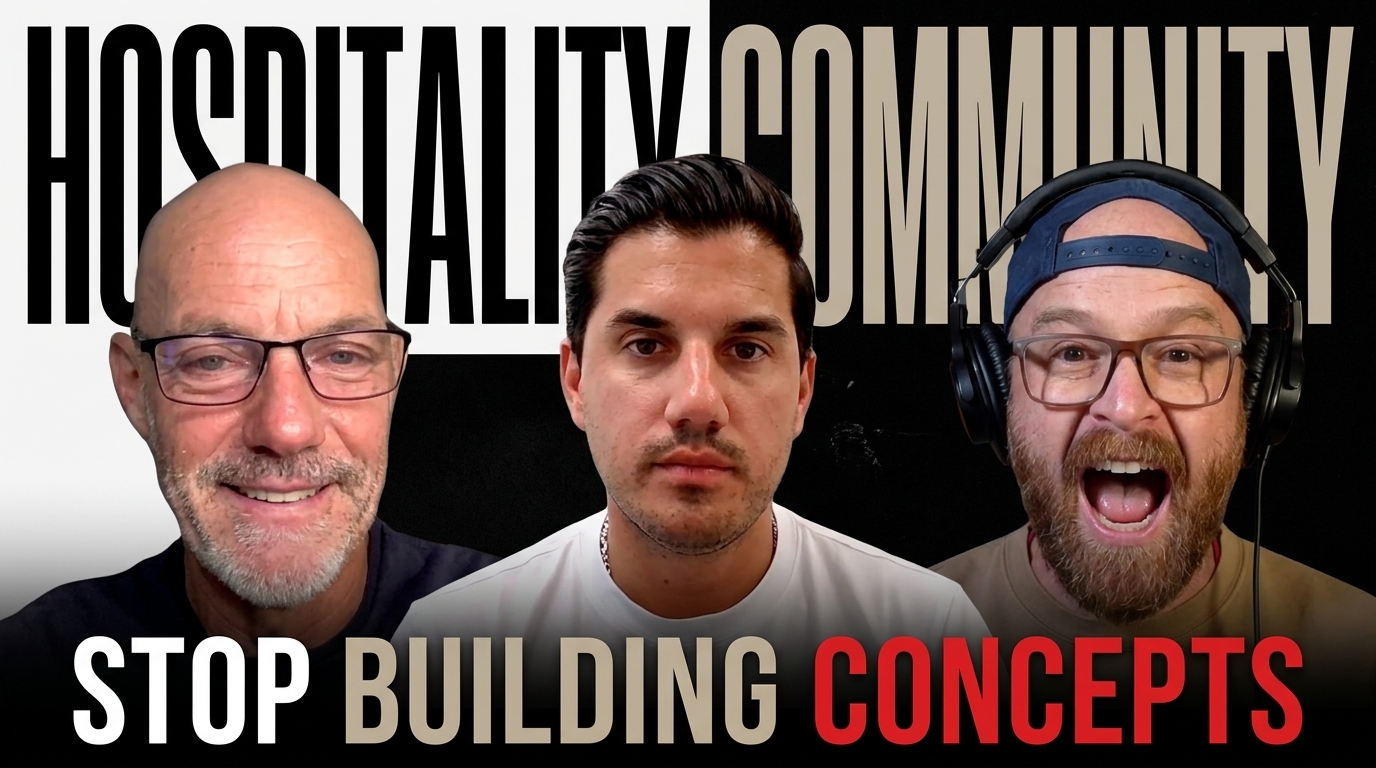
Stop Building Concepts, Start Building Community with Eric Cacciatore
Stop Building Concepts, Start Building Community
What if the restaurant industry's biggest problem isn't labor, margins, or technology, but that it forgot what a restaurant is actually for? On this episode of the Ride or Die Restaurant Show, Greg Provance and Spiro Douvris sit down with Eric Cacciatore, host of Restaurant Unstoppable and a self-described "student of hospitality," to trace hospitality back to its roots and make the case that independent restaurants need to become community builders again, not just concept developers chasing scale.
What is hospitality, really?
Eric's take reframes the entire conversation: hospitality isn't just an art or a nice-to-have, it's a survival instinct. "Hospitality is like a survival instinct," he explains. "It's literally taking the time to see people, to care for them, to do the most human thing there is." As a tribal species, humans need to feel seen and valued to feel like they belong. When a restaurant delivers real hospitality, it's tapping into something far more basic than good service: the fundamental human need to be seen and to belong to something.
Why is the restaurant industry "breaking up with hospitality and dating profit margins"?
Spiro's framing sets up the episode's central tension. Somewhere along the way, the industry got over-indexed on analytics: table turn times, throughput, and squeezing one more seating out of every shift. "We were so hospitality, and then we overcompensated by going super analytical," Spiro says. The result is an industry that forgot why people opened restaurants in the first place, and customers are responding by craving exclusive, relationship-driven experiences again, which is part of why private clubs and membership models are resurging.
Can profitability and hospitality actually coexist?
Yes, and Eric argues they have to. He points to private clubs and membership models as proof: when you have a portfolio on a regular guest, you can genuinely customize their experience, the same way you'd stock a family member's favorite drink before they visit your house. Greg pushes back constructively on the false choice: as an operator who cares deeply about throughput and efficiency, he asks where these worlds coexist. The answer, per Eric: profit isn't the enemy. "I don't think profit's nasty. I think it's necessary, but we have to look at profit as a tool, as the fuel to the machine that serves our purpose." The problem isn't having profit goals, it's forgetting what the profit is supposed to fund.
Where did restaurants historically come from, and what were they really for?
Eric's history lesson reframes the whole industry's original purpose. In colonial America, establishing a public house was one of the first things a new town needed. "The heart of that town was a public house where people congregated. It's where you got your news, your entertainment, your politics, where you socialized and broke bread." The original restaurateurs were literal community builders, not concept developers. Somewhere along the way, especially as restaurants became more about creating a scalable concept to sell than a place to belong, that founding purpose got lost.
Why do so many restaurant owners chase scale instead of community?
Because the culture around them tells them that's what winning looks like. Eric shares the story of a young restaurateur named Jeremy Fitzgerald, who wanted to learn from "the best" in college and chose to study Subway, because in his mind the biggest and fastest-growing was automatically the best. "Our culture kind of supports that. We live in this bubble where the goal is to get big fast." Layer in private equity money chasing fast-growing concepts, and independent, neighborhood restaurants increasingly can't compete for capital or real estate, pushing the whole industry further from its community-building roots.
What is the "transformation economy," and how does it apply to restaurants?
Eric draws on Joe Pine's work (The Experience Economy, followed by The Transformation Economy) to describe where the industry is heading next. Restaurants already sell experiences, not just food, but the next evolution is transformation: helping guests and employees become happier, healthier, or wealthier through their interaction with your business. "The best way to love somebody, to see them, is to help them become the best version of themselves," Eric says. Restaurants that build their culture and community around that idea, starting with their own team, are positioned to lead the industry's next era.
How should restaurant owners think about employee ownership?
As the real ceiling of what it means to take care of your people. Eric argues most restaurateurs stop at "I gave them a job," when the goal should be equity and ownership. "If you want to truly take care of your employees, the best restaurateurs are providing equity, creating more owners." Greg connects this directly to Maslow's hierarchy: security, belonging, growth, and finally self-actualization, which in a restaurant context looks like a name on the wall and a real ownership stake, not just a paycheck.
What's the single most important thing a restaurant owner can do today?
Make people feel seen and heard, starting with the team. Greg shares an example from his own client work: the "superpower lunch," where a new hire sits down with their GM or owner not just to talk about the job, but to talk about their unique strength, their "superpower," which then gets shared with the rest of the team. "When people start to learn each other's superpower and appreciate it, that forms a bond that's impenetrable," Greg explains. That's how a group of people clocking in becomes an actual team, and it's the same principle that, scaled up, turns a restaurant back into a genuine community hub.
More from the Rundown: if this one landed, go deeper with Stop Hiring Bodies, Start Hiring Believers on hiring for culture over resume, Bring the Love or It's Just a Fee on where hospitality actually lives in the guest experience, and Are You Building Drivers or Just Babysitting Doers? on turning a team into people who own the outcome.
Building a team and a community that people are genuinely proud to belong to, rather than just a concept built to scale and sell, is exactly what we help restaurant owners do inside the Leadership Circle. If this conversation resonated, learn more about the Leadership Circle here.
Want more conversations like this one? Subscribe to the Ride or Die Restaurant Show and catch every episode at gphospitalitypartners.com/podcast. And be sure to check out Eric Cacciatore's own podcast, Restaurant Unstoppable, for more on the art of hospitality.