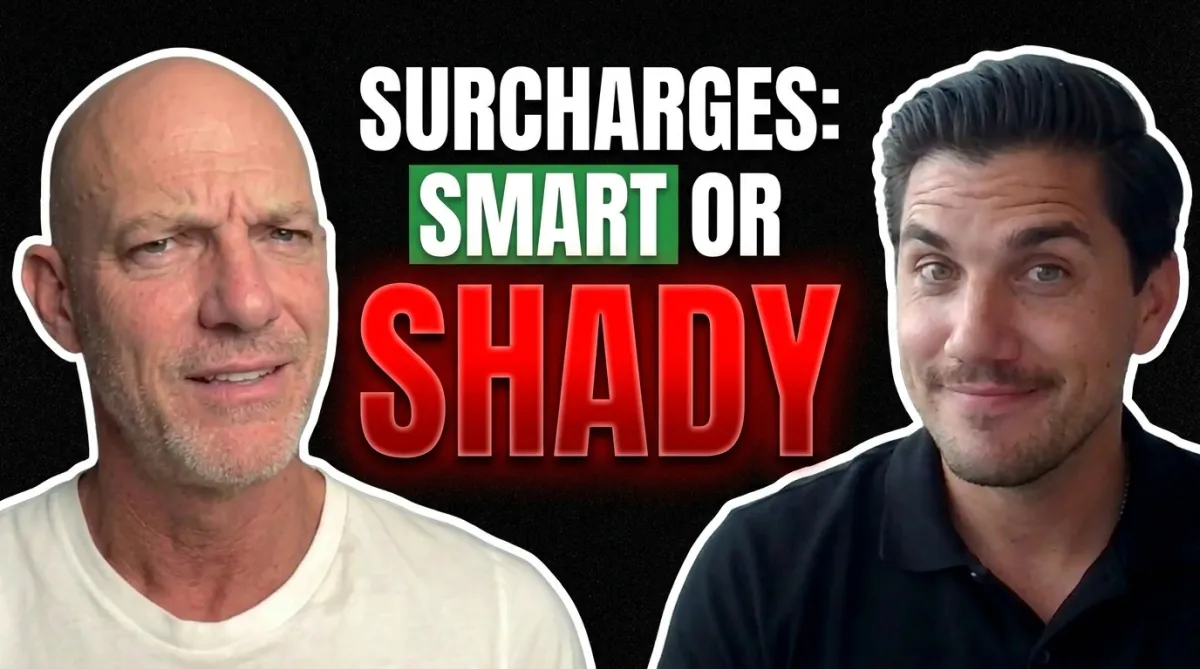
Surcharges: Smart Business or Ripping Off Your Customers?
Every restaurant owner hits the same fork in the road eventually. Credit card processing is eating your margin, and you've got three options: eat the cost, tack on a visible surcharge, or bury it in your menu prices. On Episode 1 of the Ride or Die Restaurant Show, Greg Provance and Spiro Douvris argue it out, and land somewhere most operators don't expect.
The real math behind the fee
Back in 2010, roughly 70% of restaurant transactions were cash. Today it's closer to 14% cash, meaning 86% of sales run through a card. On $100K in monthly sales at a 3% processing rate, that's about $2,600 a month in fees today versus roughly $2,100 in 2010 at the old cash ratio. That's a real 20% increase in processing cost over fifteen years, and it's the reason surcharges started showing up on receipts in the first place.
Why guests hate seeing it on the bill
Here's the part that gets missed. It's not really about the money. Three percent on a $10 burger is thirty cents. Nobody's walking out over thirty cents. What they're reacting to is the moment itself: you already agreed to a price, and now there's an extra line item you didn't see coming. That feels like a bait and switch, even when it isn't one. Data referenced on the episode puts a majority of consumers in the "I'll avoid businesses that do this" camp, which means the fee isn't just a pricing decision, it's a guest experience decision.
One group's real experience
Greg worked with a well-known San Diego restaurant group that rolled out a 4% surcharge in response to rising labor costs, fully expecting backlash. It didn't come. A handful of complaints, all removed immediately, and otherwise close to silence. Years later, they're still running it. Worth noting: that's a big, established group with brand equity and infrastructure most independents don't have. A single-unit operator without that cushion is taking a bigger risk with the same move.
The debit card trap
Surcharging a debit transaction, even one run as credit, is illegal under federal and card network rules. On top of that, several states have banned surcharging outright, and the rules shift state to state and change often. If you're considering a surcharge, that's a compliance question for your POS provider and possibly your attorney before it's a marketing question.
The same fee, different direction
Spiro raises the sharpest point in the episode: restaurants that add a surcharge to protect their margin are doing the exact same thing they complain about when DoorDash and Uber Eats pass fees onto them. Can't be frustrated by a fee going one direction and comfortable charging one the other way.
Where they land
Both hosts land on the same answer: build the cost into your menu price instead of surcharging. Thirty cents on a $10 item, a buck fifty on a $40 steak, nobody notices or cares. What guests do notice and do care about is friction at the exact moment they're deciding whether they had a good experience. Every cost of doing business is already baked into your menu price today. This is just one more.
The exception is brands with real scale and loyalty to absorb the reaction, the kind of group that can post the fee with a no-questions-removed policy. For most independent and multi-unit operators still building that kind of trust, raising prices quietly wins over surcharging loudly.
Quick Takeaways
- Card processing costs have risen roughly 20% since 2010 as cash transactions dropped from about 30% to 14% of sales.
- Surveys cited on the episode show a majority of consumers say they'd avoid a business that adds visible surcharges.
- Surcharging a debit card transaction is illegal under federal and card network rules, even when it's run as credit.
- Several states ban surcharging outright, and the rules change frequently, so check current law before adding one.
- Both hosts recommend building the cost into menu pricing over adding a visible surcharge for most independent operators.
FAQ
Is it legal to charge a credit card surcharge in a restaurant?
In most states, yes, with disclosure requirements, but several states ban it outright and the list changes. Check your state's current law before implementing one.
Is it legal to surcharge a debit card transaction?
No. Surcharging debit transactions is prohibited under federal and card network rules, even if the transaction is processed as credit.
Should a restaurant add a credit card surcharge or just raise prices?
For most independent and multi-unit operators, raising menu prices slightly causes less guest friction and carries less legal risk than a visible surcharge. Large, established brands with strong loyalty have more room to do either.
More from the Rundown: for more on the financial side of running a restaurant, see You're Not Broke, You're Just Bad at Cash Flow, Cut Your Menu 30% or Keep Bleeding Money, and Third-Party Delivery Isn't Killing Your Restaurant. Your Mindset Is.
Knowing exactly how a pricing decision like this affects your margin, your guests, and your risk, that's the kind of financial clarity we build into the Leadership Circle. If this conversation resonated, learn more about the Leadership Circle here.
Want more conversations like this one? Subscribe to the Ride or Die Restaurant Show and catch every episode at gphospitalitypartners.com/podcast.